The Unio demo environment is online. Open the console

One patient record across all your repositories

Unio federates any number of openEHR repositories behind a single endpoint, whether they sit in one institution, a hospital group or a whole region. Clinicians see one history. Every record stays in the system that created it.

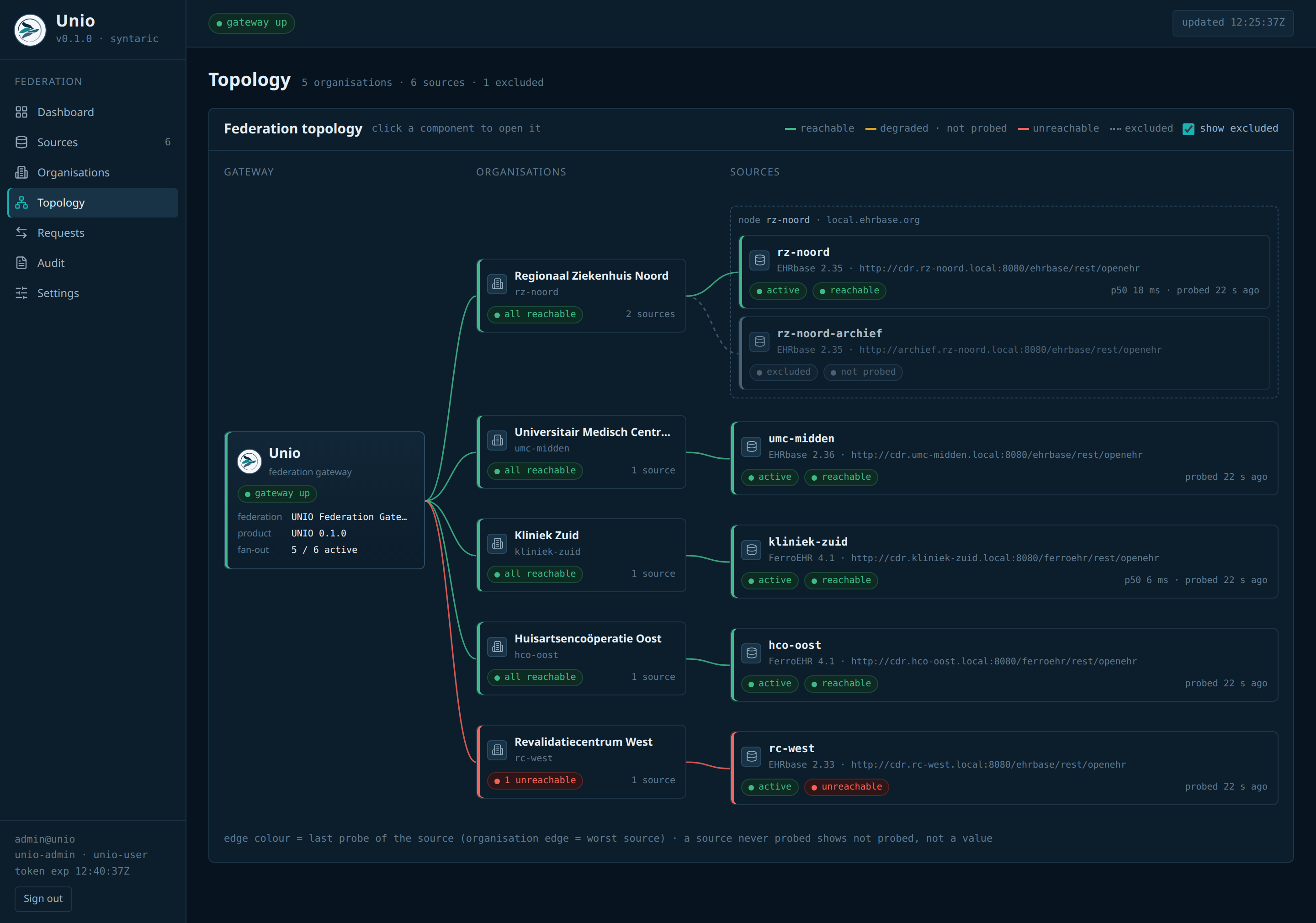
The Unio operator console topology view: the gateway on the left, five federated organisations in the middle and the openEHR repository behind each on the right, with the connecting edges coloured by the last probe.

The federation at a glance in the operator console: Unio, the organisations it federates and the repository behind each. Every member is probed once a minute and each edge carries the result.

Who do we help?

Regions and health networks

Give every clinician in the network one view of the patient, without a central data warehouse and without a migration programme.

Find out more

Hospitals and care organisations

Join a shared record while keeping your own repository and applications, or federate the several CDRs you already run inside one institution.

Find out more

Application vendors and integrators

Build against one openEHR endpoint for the whole federation instead of one per repository. Existing openEHR applications need no changes.

Find out more

Many repositories. One openEHR endpoint.

Applications talk to Unio exactly as they would to a single clinical data repository. Unio finds the records across the federation, queries each member in place and returns one answer.

Applications Shared record viewer Hospital EHR Research and analytics openEHR REST Unio federation gateway Identity Fan-out Merge Audit Member repositories Hospital A openEHR CDR · data stays here Clinic B openEHR CDR · data stays here Department C openEHR CDR · data stays here No central copy of clinical data. Each repository is queried in place, in parallel, with a timeout per member.
01

A request arrives

An application sends an ordinary openEHR request to Unio, exactly as it would to a single CDR.

02

Identity is resolved

Unio matches the patient centrally and works out which members hold a record. Members that hold nothing are not asked.

03

Members answer in parallel

Each repository is queried over its standard openEHR interface. A slow or unreachable member does not block the others.

04

One result, with provenance

Results are merged in time order and deduplicated. Each entry names its source. If a member could not be reached, the response says so.

ExtensionopenFHIRFHIR R4

The same federation, reached over FHIR

Applications that speak FHIR rather than openEHR get the same federated record. openFHIR sits in front of Unio and exposes a FHIR API. A FHIR query is translated into AQL, Unio runs it across the member repositories, and the merged openEHR result is mapped back into FHIR resources on the way out.

openFHIR is also a SYNTARIC product, so the two are built to work together. Unio joins the openEHR repositories into one record; openFHIR opens that record to the FHIR world, including national exchange platforms and the European Health Data Space. Together they give a federation one openEHR endpoint and one FHIR endpoint, both backed by the same data, with one team behind them.

  • One FHIR endpoint for the whole federation, with no FHIR server at any member
  • One set of mappings, written once in the open FHIR Connect specification
  • Identity resolution, provenance, partial-result flags and audit work exactly as before
  • Members keep running plain openEHR repositories; nothing changes on their side
More about openFHIR

FHIR application FHIR search FHIR Bundle openFHIR FHIR API · FHIR search → AQL · openEHR → FHIR mapping AQL merged openEHR result Unio federation gateway identity · parallel fan-out · merge and provenance · audit openEHR REST, in parallel Hospital A openEHR CDR Clinic B openEHR CDR Department C openEHR CDR Members stay plain openEHR. FHIR exists only at the edge.

See what the operator sees

The operator console shows how the federation is behaving: which members are reachable, how quickly each one answers, and every request that crossed an organisational boundary. It stores no clinical data and no patient identifiers.

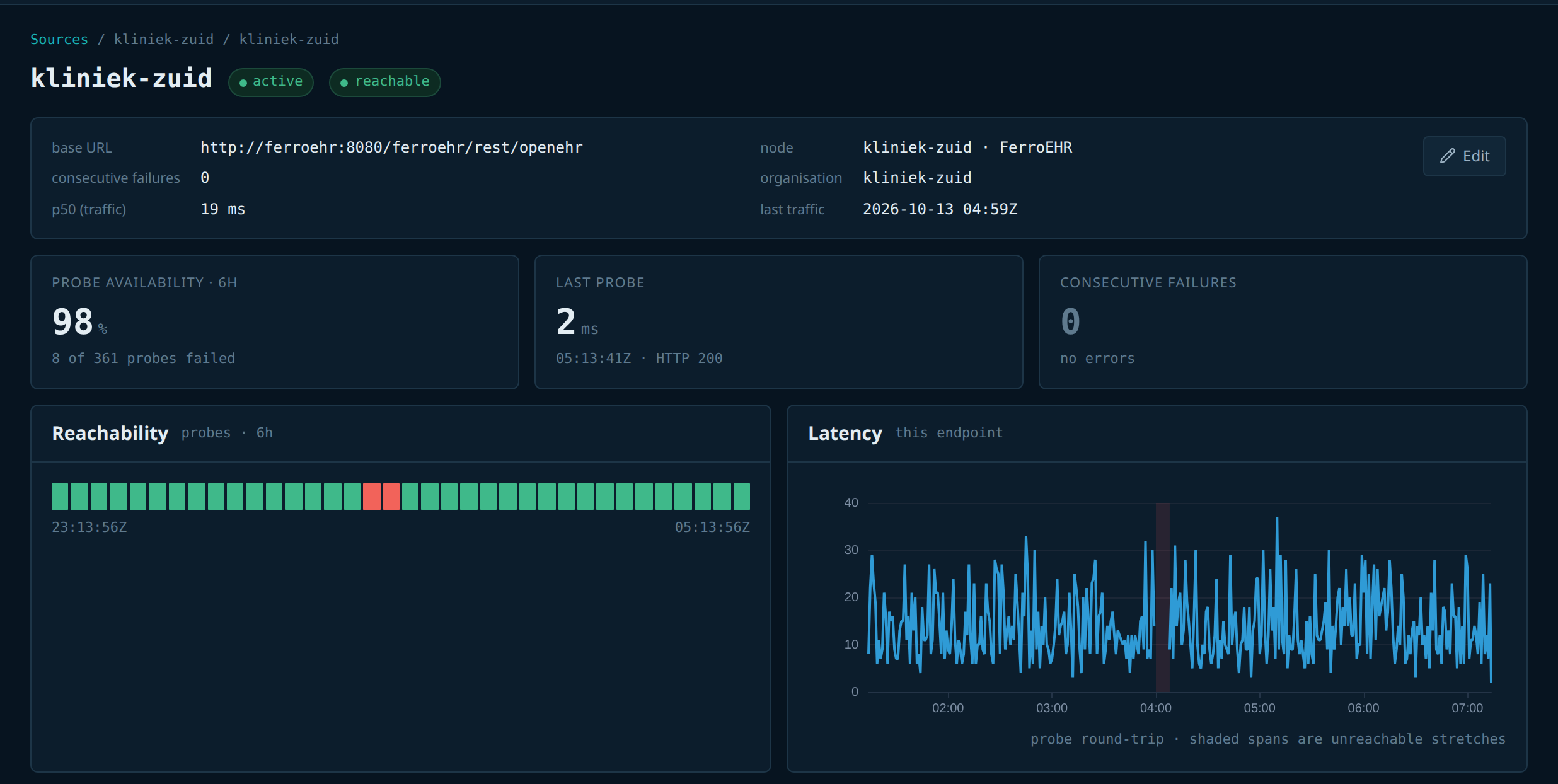
One member's page in the console: probe availability over six hours, a ribbon of probe outcomes and the latency chart with an outage marked.
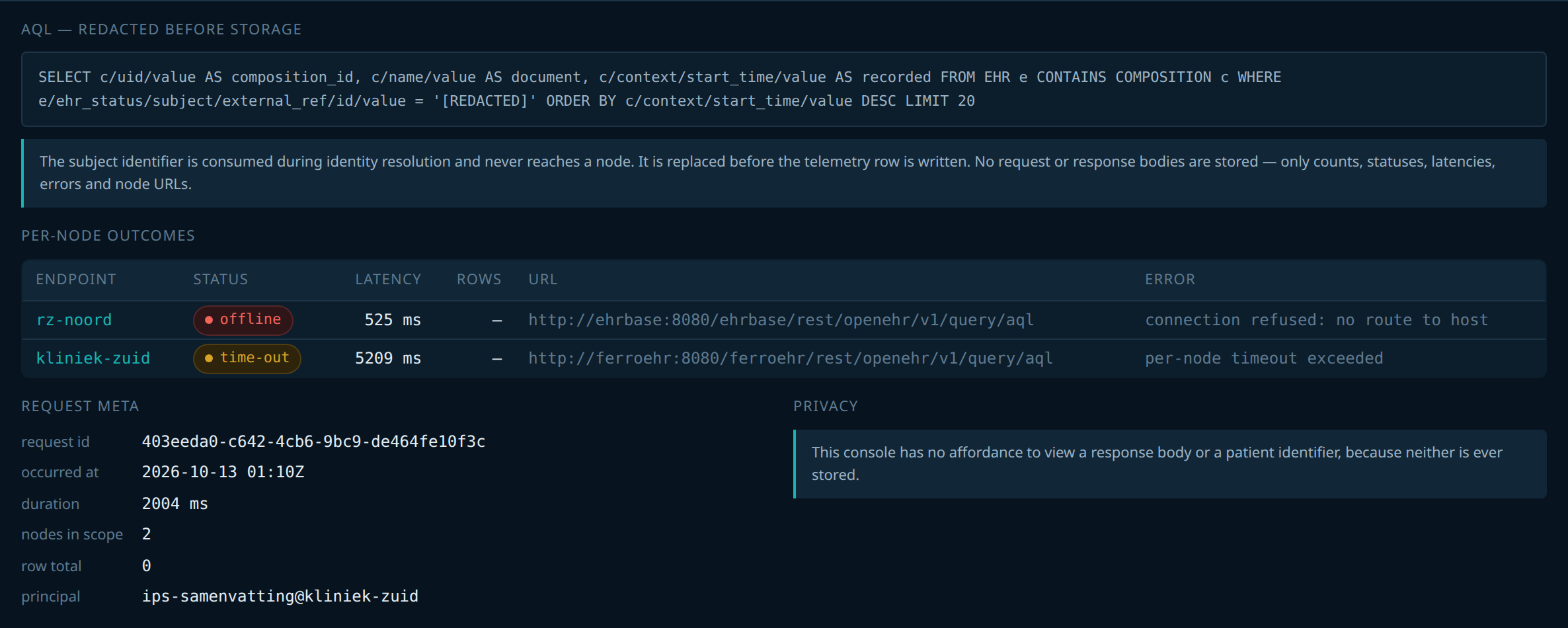
A request as stored by Unio: the AQL query with the patient identifier redacted and the outcome per member.

Built for federations that keep data where it is created

Unio is the shared record for any set of openEHR repositories whose owners keep their own systems: the departments of one institution, the hospitals of a group, or the care organisations of a region. Three capabilities make that work.

A clinician working at two monitors in a hospital office.
Federation gatewayopenEHR RESTAQL

A single openEHR endpoint for the whole federation

The gateway accepts standard openEHR requests, including AQL, and resolves them across the member repositories. Applications do not need to know which organisation holds which record.

  • Existing openEHR applications connect without modification
  • Parallel fan-out with a timeout per member
  • Merged, deduplicated results with the source on every entry
How it works
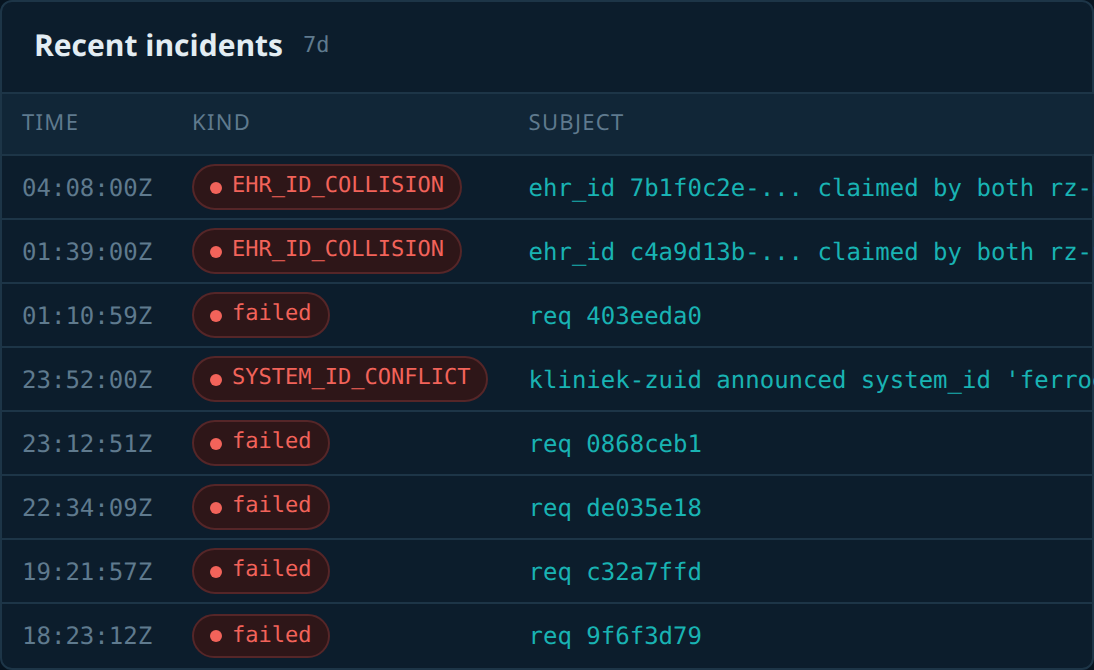
The recent-incidents panel of the console: failed requests and identifier conflicts between members.
Operator consoleMonitoringAudit

Full audit, without clinical data

Every request is recorded with the requesting principal, the members asked and the time each took. Patient identifiers are replaced before the record is written. No request or response bodies are stored.

  • Request volume, error rate and p95 latency over 1 hour to 7 days
  • Incidents such as failed requests and identifier conflicts
  • Nothing in the console can display a clinical fact
See the console
Two clinicians discussing information on a screen.
GovernanceMember autonomy

Terms the most cautious member can accept

Data stays with its owner. Care recorded in one system is written to that system's repository and nowhere else. Joining and leaving the federation are configuration changes, and a member that leaves takes nothing away from anyone else.

  • No central copy of clinical data to secure or keep current
  • One ordinary query per request, no bulk extracts, no replication
  • Partial results are declared partial, never presented as complete
For source systems

What joining asks of a source system

Unio sits in front of the federation and speaks to each member repository over the openEHR interface it already exposes. There is nothing to install on the member's side.

Replace or migrate the CDRNot required
Change existing applicationsNot required
Software inside the organisationNone
Load on the repositoryOne query per request
If the system is offlineThe federation continues and says so
Leaving the federationA configuration change

Frequently asked questions

The questions programme leads and IT directors ask in the first meeting.

Do we have to replace or migrate our clinical data repository?

No. You keep the repository you have. Unio queries it over the standard openEHR REST API it already supports. Nothing is installed on your side.

Which openEHR repositories does Unio work with?

Any repository that exposes the standard openEHR REST API can be a member. Our demonstration environment federates EHRbase and FerroEHR repositories.

Do our own applications have to change?

No. Applications built against a single openEHR repository work against the federation through Unio without modification. There is no federation-specific API to adopt.

Can applications use FHIR instead of openEHR?

Yes, by putting openFHIR in front of Unio. openFHIR exposes a FHIR API, translates FHIR queries into AQL for the federation and maps the merged openEHR result back into FHIR resources. The member repositories stay plain openEHR and need no FHIR server of their own. openFHIR is also developed by SYNTARIC, so the two products are designed and supported together.

Does Unio store clinical data?

No. Unio keeps only request metadata: counts, statuses, latencies, errors and member URLs. Patient identifiers are replaced before a request is written to the log, and no request or response bodies are stored.

Where does Unio run?

Unio is delivered as a Docker image and runs on Linux. The organisation operating the federation deploys and runs it in the infrastructure of its choice.

What happens when a member is slow or offline?

Each member has its own timeout. A member that does not answer in time is reported as unreachable, the other members' results are returned, and the response is marked as partial. The outage is visible in the operator console.

Can a member leave the federation later?

Yes. Because nothing was copied out of the member's repository, leaving is a configuration change on the gateway. The member's records are already, and only, in its own system.

Get in touch

Tell us what you are looking at and we will set up the right session: a demonstration for a region or hospital group, a technical briefing for IT, or commercial information.

Unio is developed by SYNTARIC.
info@syntaric.com

I would like

We use these details only to respond to your request. We usually reply within two working days. Prefer email? Write to info@syntaric.com.

Ready to see one record across all your repositories?

Request a demo